This post contains affiliate links and is a member of the Amazon Services LLC Associates Program. If you make a purchase using one of these affiliate or Amazon links, I may receive compensation at no extra cost to you.
17 Stunning Wood Slat Accent Wall Behind Bed Ideas Worth Saving

A wood slat accent wall behind the bed is one of those rare design moves that looks expensive, feels intentional, and works in almost every bedroom style you can throw at it. We’re talking about vertical or horizontal slats mounted directly to your headboard wall — creating warmth, depth, and that unmistakable sense of a room that was actually designed rather than just furnished. It sits right at the intersection of biophilic design, Japandi minimalism, and organic modern style, which is probably why it keeps showing up in every bedroom mood board worth pinning.
This list covers 17 real, specific ideas — from a dead-simple DIY peel-and-stick version to full architectural floor-to-ceiling natural wood panels with integrated lighting. You’ll find ideas for small bedrooms, primary suites, rental-friendly installs, and maximalist takes that go way beyond the basic batten. Whether you’re drawn to light airy oak, moody walnut, or painted slats in a chalky neutral, there’s a version here that fits your space and your Saturday afternoon.
One thing before you scroll: commit to the headboard wall only. Slats on every surface is the fastest way to make a bedroom feel like a sauna showroom. One wall, done well, is always the move.
What Designers Are Saying
What designers and design publications are saying about wood slat walls in 2026 is actually a bit more nuanced than the trend pieces suggest — and it’s worth knowing before you commit to an install.
According to Luxury Tiles, interior design in 2026 is no longer just about how a space looks — it’s about how it feels, how it sounds, and how well it supports the way we live. Their reporting specifically calls out the bedroom as one of the highest-value applications for slat panels, noting that wood slat panels help absorb sound from adjoining rooms, contributing to better rest and relaxation while adding warmth and depth that creates a calm, hotel-inspired atmosphere.
The more interesting tension in the design conversation right now is about execution quality. Saltwood Interiors notes that a well-placed wood slat wall can serve as a stunning focal point, but overuse can diminish the impact, overwhelming the design and losing the sense of balance that makes spaces inviting. The designers who are doing this best right now are also the most restrained — one wall, thoughtful proportions, real materials. The trend is also evolving toward full wall coverage, 3D profiles, and darker wood tones like walnut and smoked oak — which tracks with what we’re seeing on Pinterest boards this season.
1. Floor-to-Ceiling Natural Oak Slat Wall as a Built-In Headboard
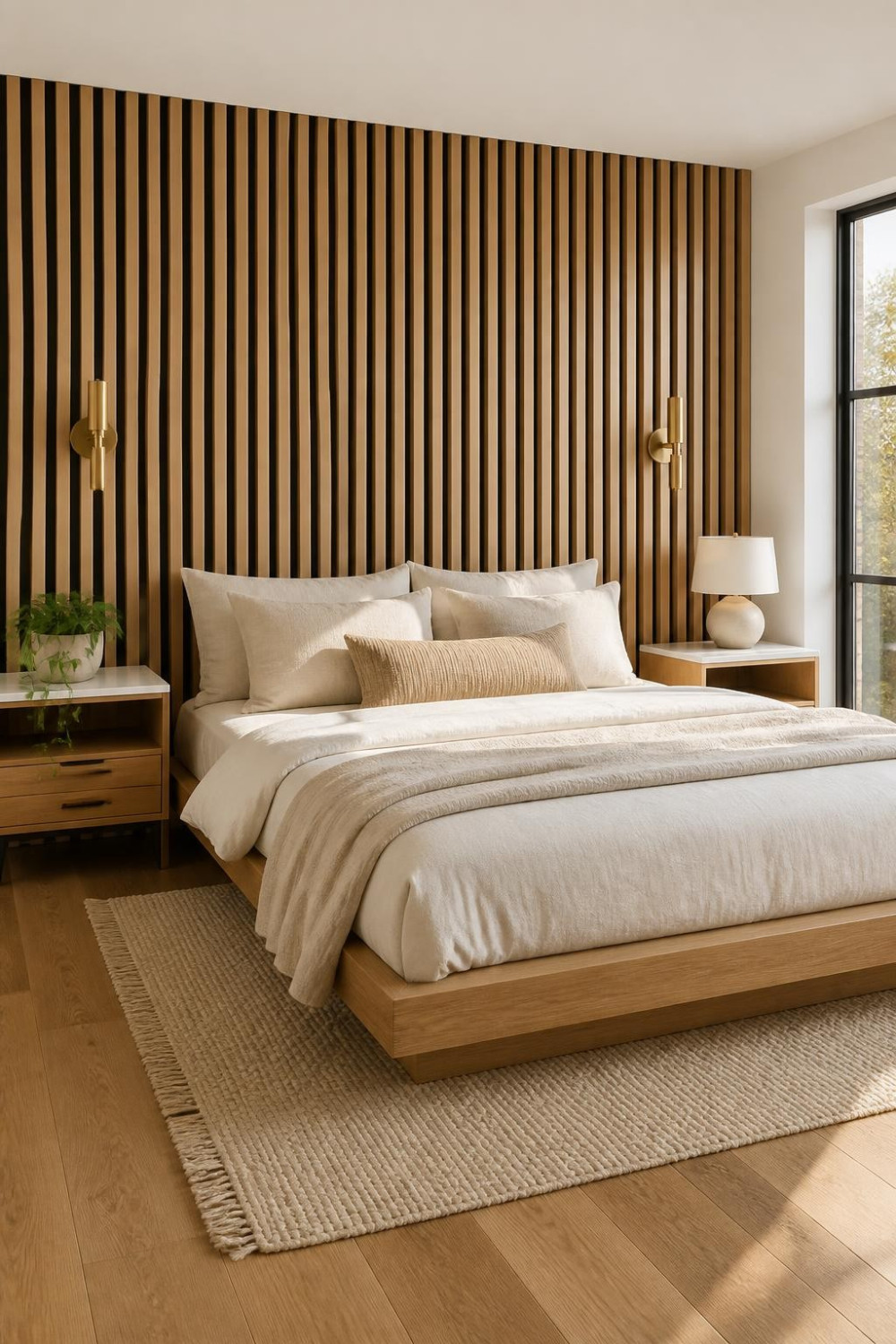
This is the one everyone’s saving on Pinterest. Full-height oak slats run from the baseboard all the way to the ceiling behind the bed, completely replacing a traditional headboard. It anchors the bed visually in a way no free-standing headboard ever could. The vertical lines draw the eye upward, which makes even an 8-foot ceiling feel taller. It works best in a primary bedroom where the bed sits centered on that wall — symmetry really matters here. Light oak reads warm and airy; go with a matte finish so it doesn’t bounce light around at night. Pro tip: paint the backer wall (the surface behind the slats) in a deep contrasting color like charcoal or forest green to give the slats shadow depth and make the grain pop.
2. Smoked Walnut Slats for a Moody, Hotel-Inspired Bedroom
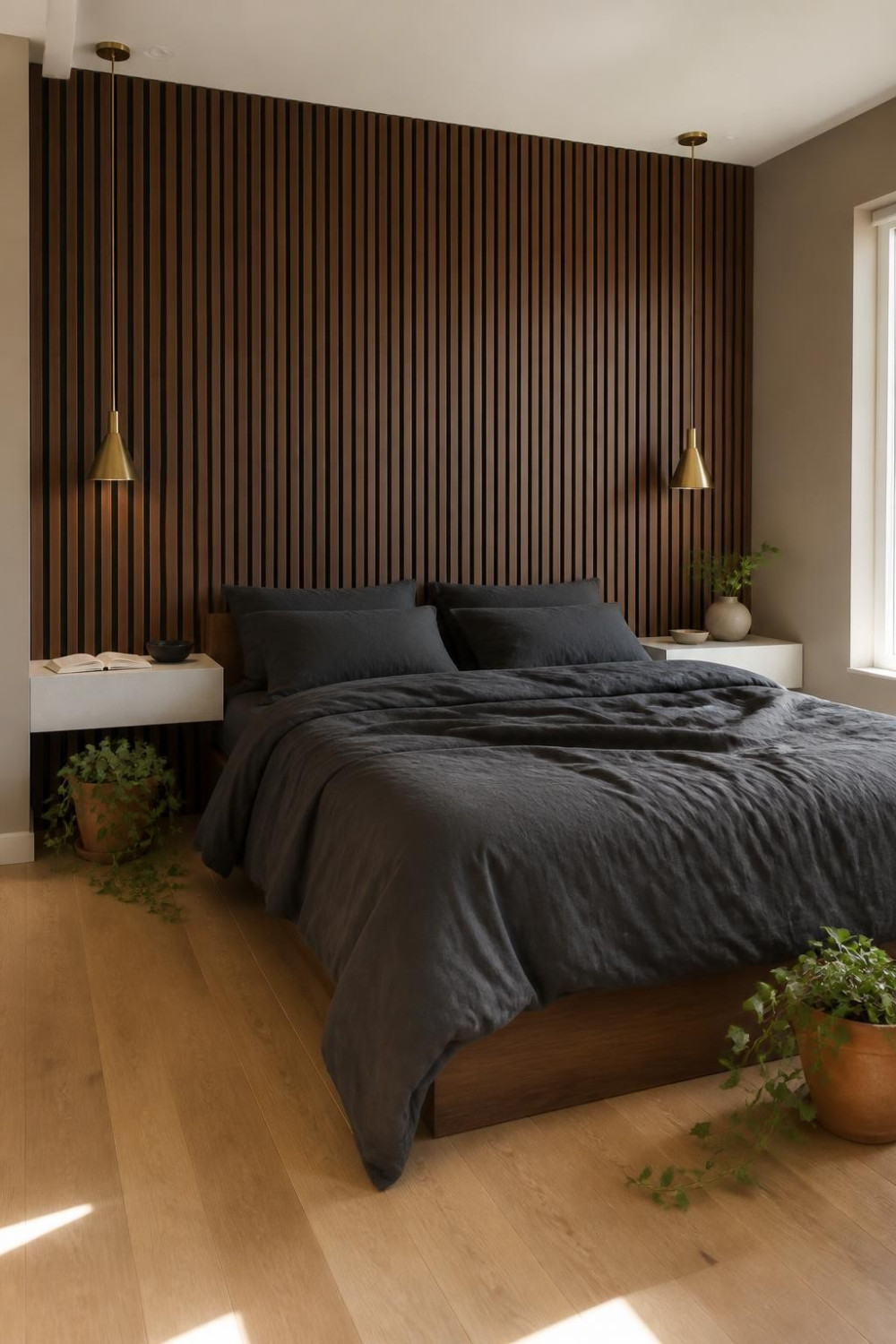
Walnut is having its moment and it absolutely deserves it. Rich, dark, almost chocolate-brown slats behind the bed create that cocooning atmosphere you feel in a really good boutique hotel. It’s not a dramatic look — it’s a confident one. Pair it with warm linen bedding, aged brass hardware on your nightstands, and a single warm-toned pendant on each side. The darkness won’t make the room feel small if you keep the rest of the walls light — a creamy white or warm greige on the other three walls keeps things from tipping into a cave. Why it works: smoked walnut has natural variation in its grain, so even a flat slat wall has texture that catches light differently throughout the day.
3. DIY Peel-and-Stick Wood Slat Panel for Renters
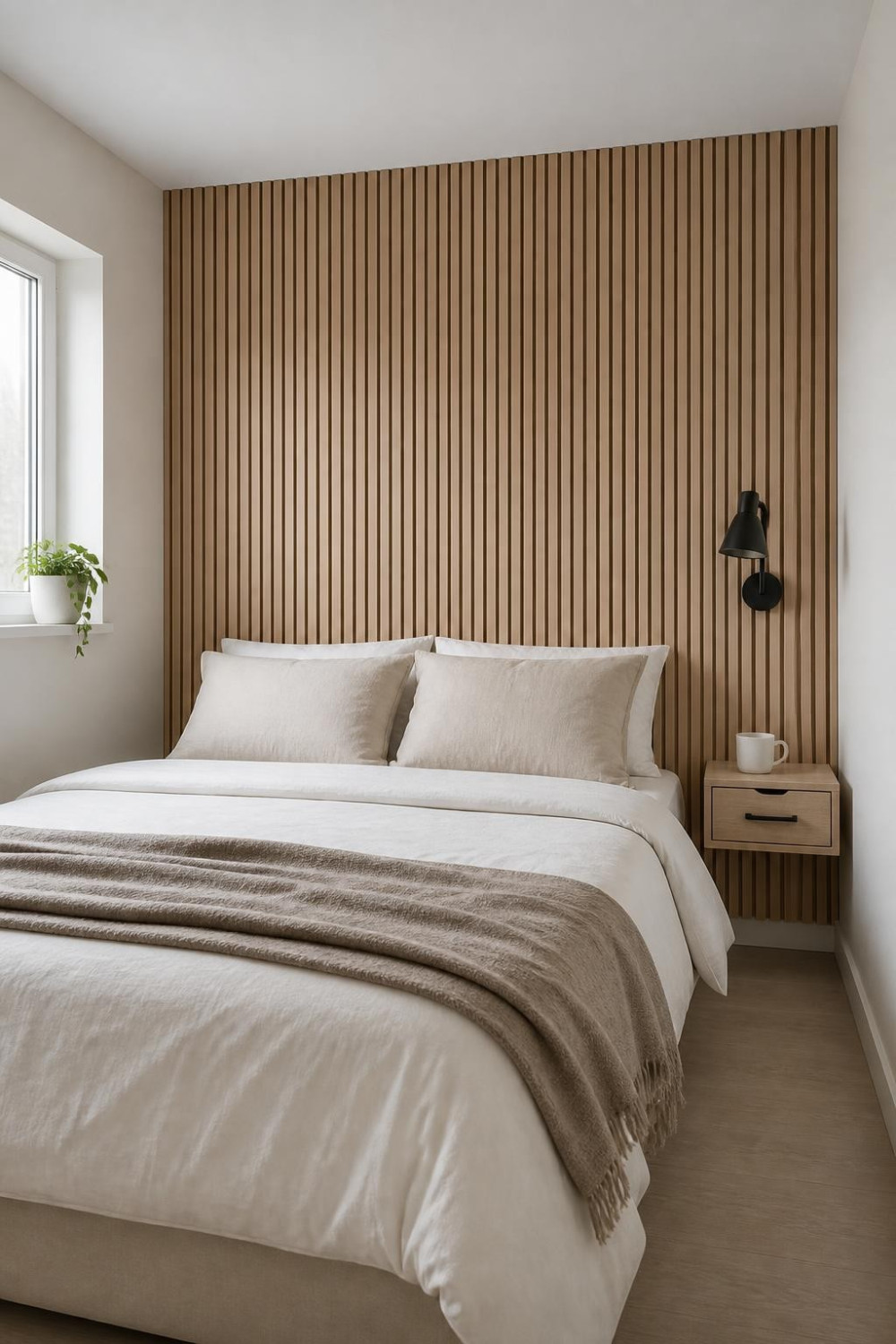
Rental-friendly and genuinely good-looking — yes, both things are possible now. Peel-and-stick wood slat panels have gotten sophisticated enough that most guests won’t know the difference from a real install unless they press their nose against the wall. They’re typically real wood veneer over a self-adhesive backer and they go up in an afternoon. You do need a flat, clean wall for adhesion, so skim-coat any major texture first. The removal process is slow and careful, not a rip-it-off situation, but they come off without pulling drywall if you take your time. Swap: if you want a warmer tone than what the kit offers, seal the panels with a water-based tinted wax after install — it deepens the color and protects the veneer.
4. Painted White Slats on a Dark Wall for a Scandinavian Bedroom
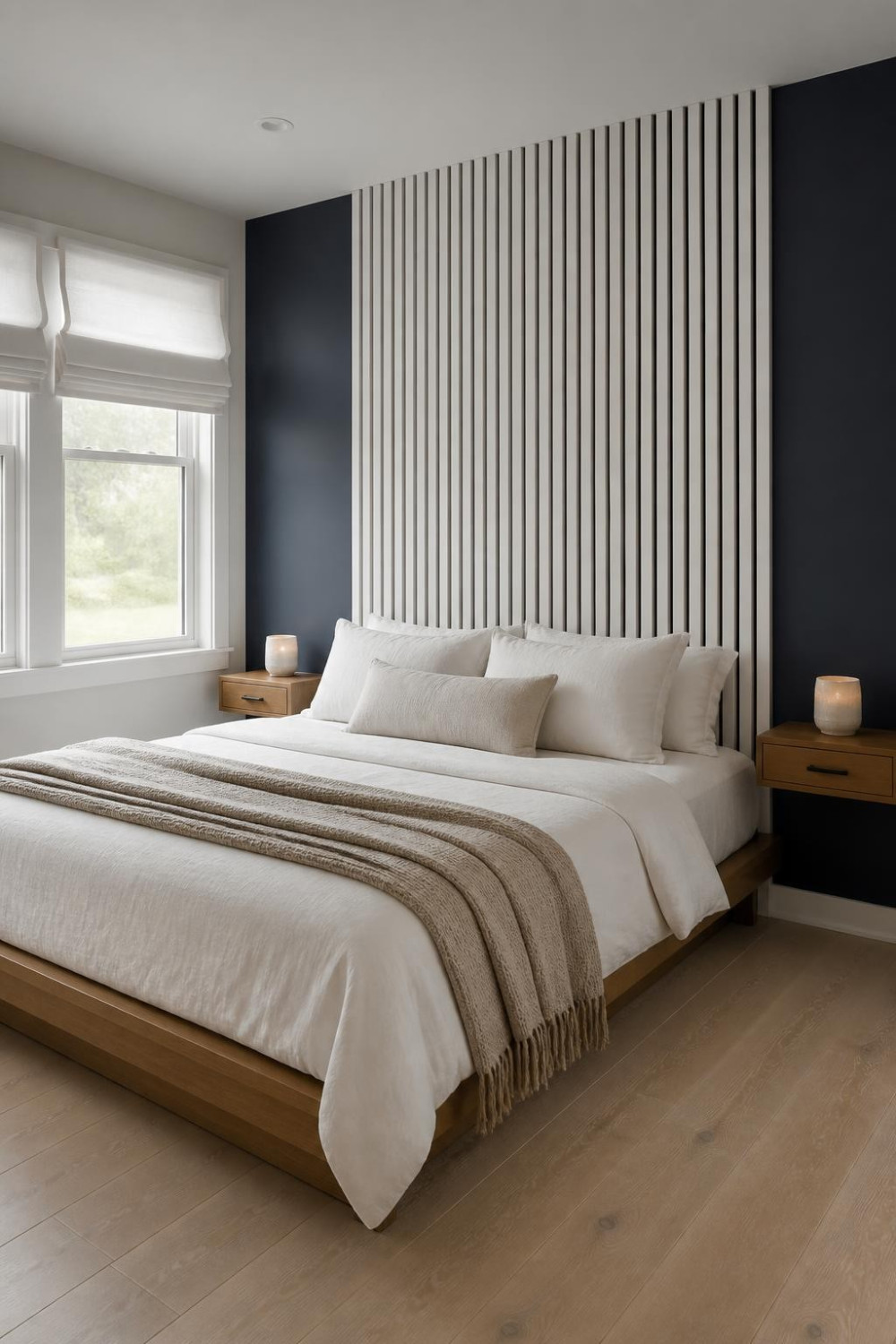
Nobody says slats have to be natural wood tones. White-painted slats against a deep navy, slate, or charcoal background is one of the cleanest things you can do in a bedroom. The painted finish reads more graphic and sculptural — less cabin, more Copenhagen. It suits a Scandi or Japandi-style bedroom beautifully, especially alongside natural linen, simple ceramic lamps, and low-profile furniture. Use a semi-gloss or satin finish on the slats so they have just a tiny bit of sheen that the dark wall doesn’t — that contrast is what makes the whole thing breathe. Tip: keep the slat width narrow (1.5 to 2 inches) for the painted version — it keeps it architectural rather than looking like shutters.
5. Horizontal Wood Slat Headboard Wall for a Low, Wide Bedroom
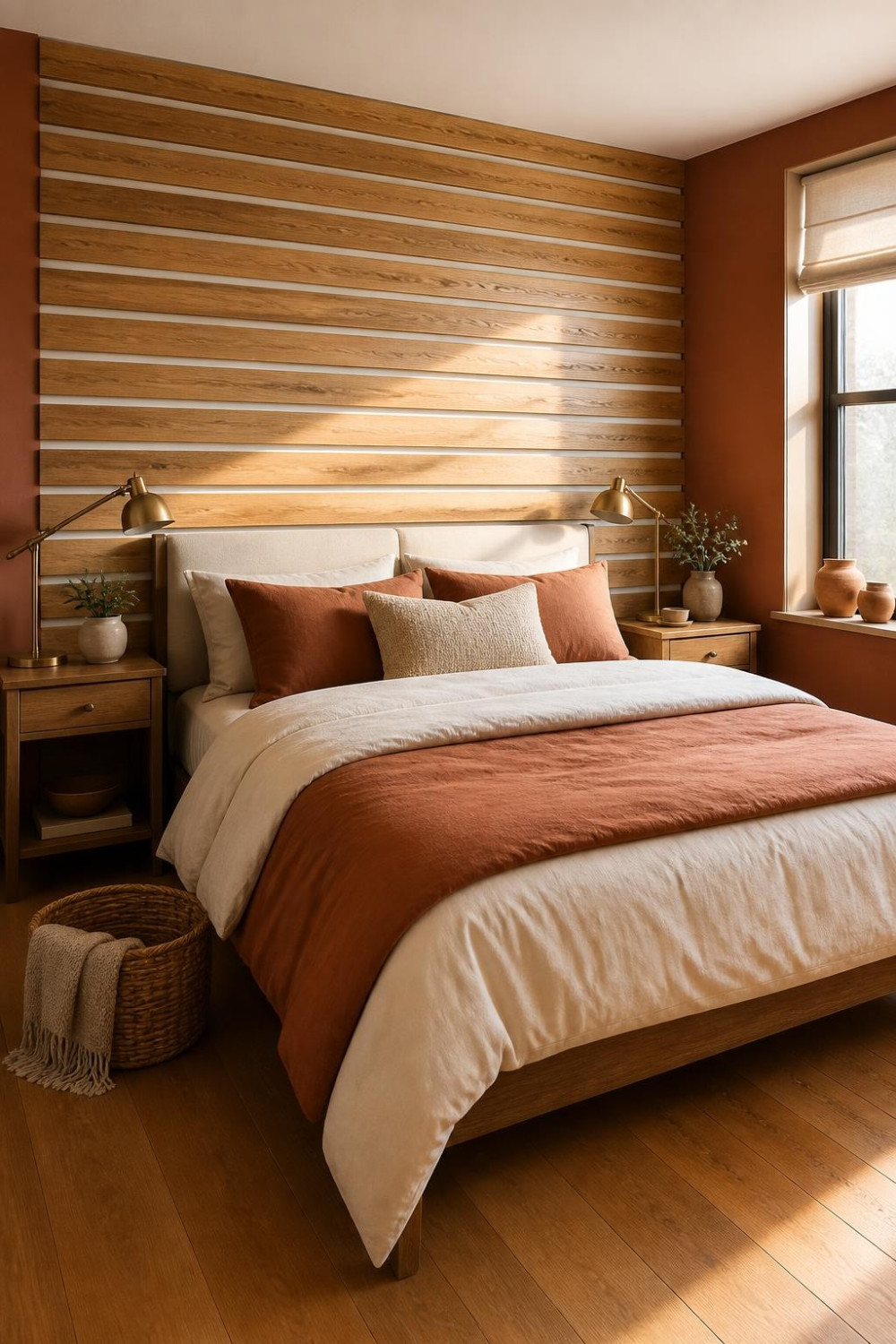
Vertical slats get all the attention but horizontal ones deserve a look, especially in rooms that are wider than they are tall. Running the slats horizontally creates a strong sense of grounding — the room feels settled and calm rather than reaching upward. It also reads more mid-century modern and less contemporary Scandinavian, so if you’ve got a warm, earthy bedroom with terracotta tones and leather accents, horizontal slats will feel far more at home. The install is the same process as vertical, just rotated 90 degrees. Use a wider slat here — 3 to 4 inches — and space them a bit farther apart. Why it works: horizontal lines visually widen a room, so this direction is especially smart in small square bedrooms where a little extra perceived width matters.
6. Acoustic Wood Slat Panels with Felt Backing Behind the Bed
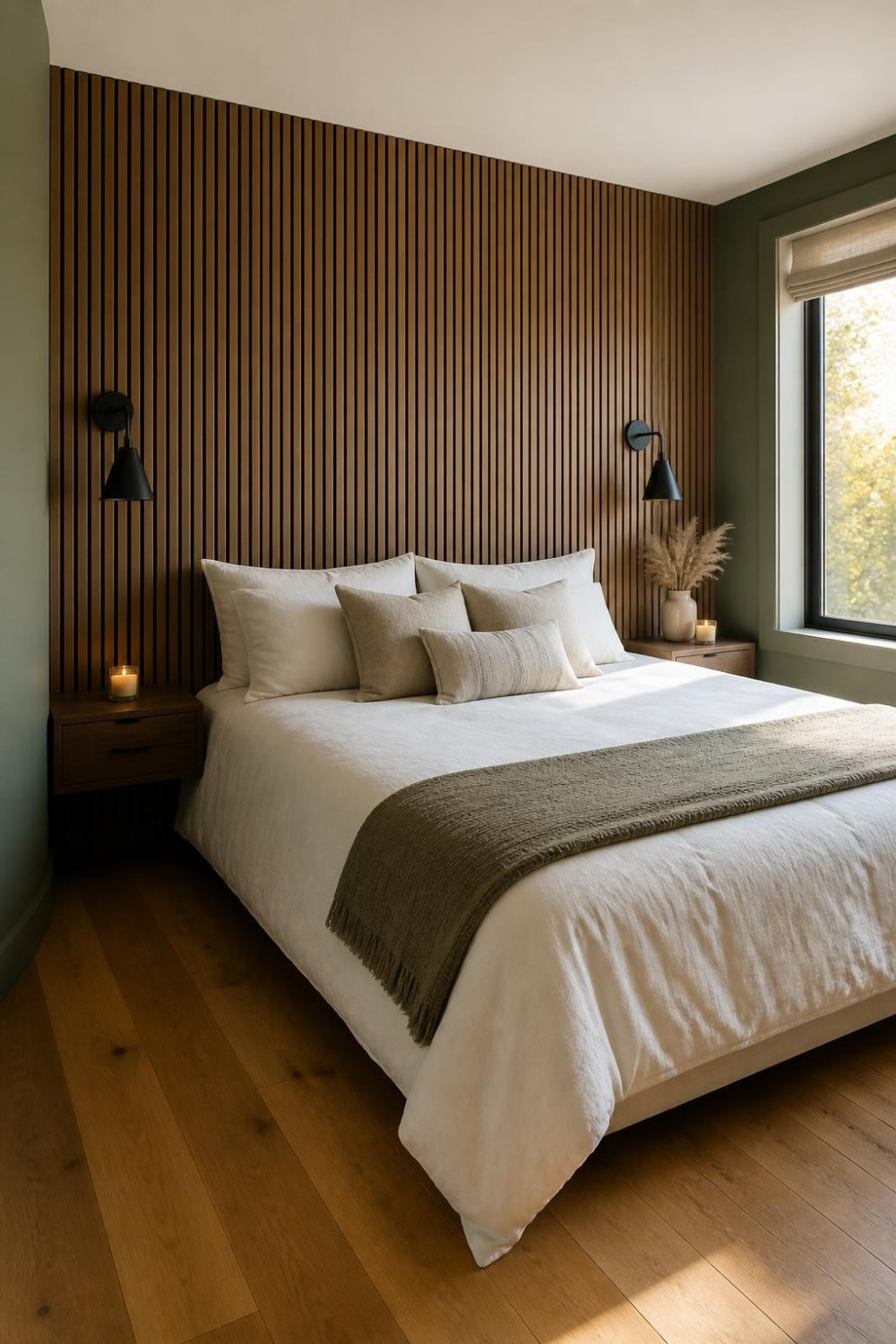
Here’s one that does more than look good. Acoustic slat panels use a felt or mineral wool backing behind the wood slats to absorb sound — they genuinely reduce echo and ambient noise in the room. For a bedroom, that means less noise bleed from adjacent rooms and a quieter, more sleep-friendly environment. The felt backer is hidden behind the slats so you’d never know it’s there visually. They’re typically the same price point as standard slat panels and install identically. If your bedroom is on a street-facing wall or shares a wall with a bathroom or living room, these are worth the conversation. Pro tip: acoustic slat panels perform best when mounted with a small air gap between the panel and the wall — even a half-inch gap improves their sound-dampening significantly.
7. Partial Slat Wall Framing Just the Headboard Zone
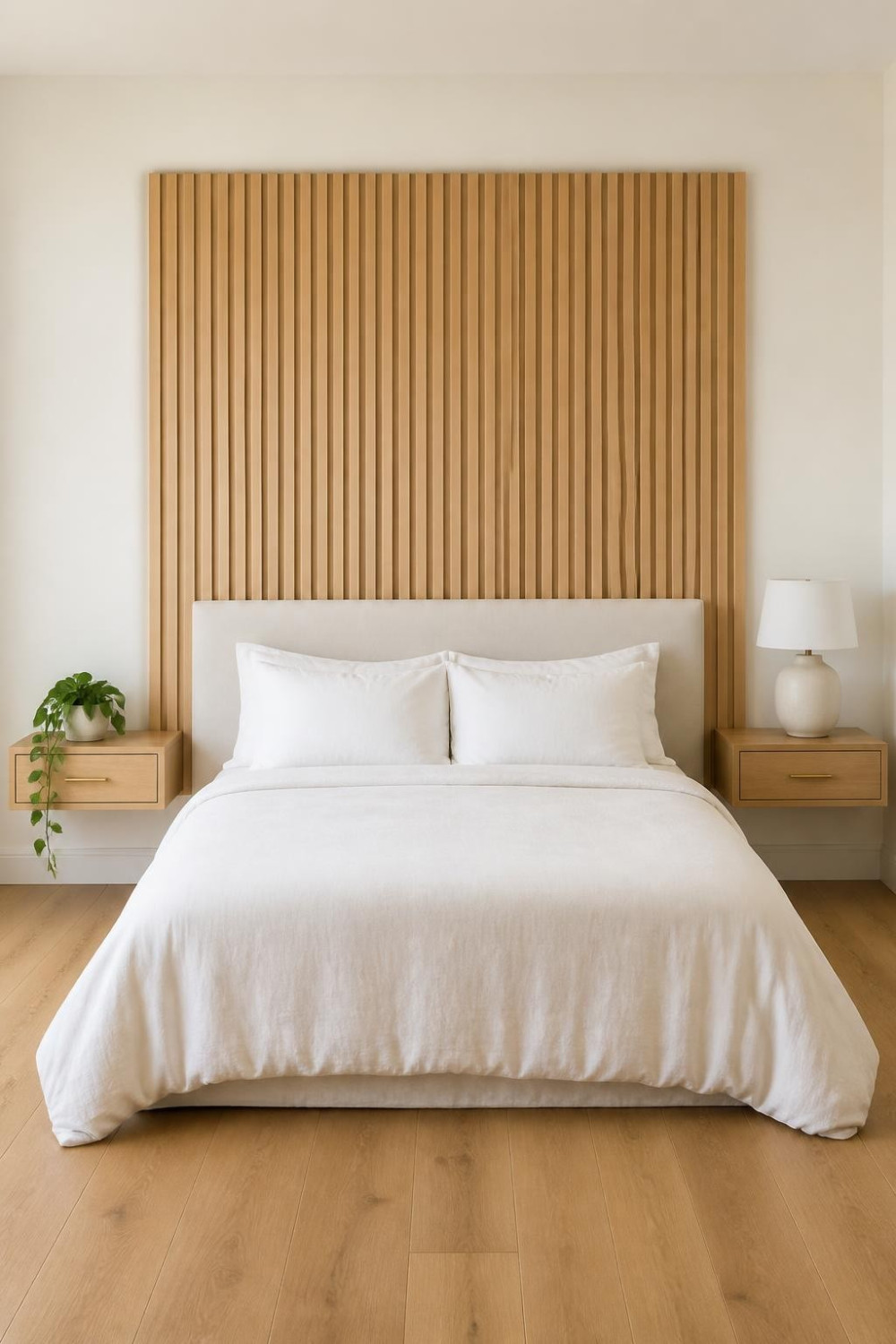
You don’t have to cover the whole wall. A partial slat panel that spans only the width of the bed — maybe 6 to 8 feet wide and 4 to 5 feet tall — frames the headboard zone without dominating the room. It’s a more restrained approach that suits smaller bedrooms or anyone who wants the effect without fully committing to an architectural installation. Think of it like a big piece of wall art that happens to be made of wood. Center it perfectly behind the bed and make sure it extends at least a foot wider than the bed frame on each side — otherwise it reads as too tight. Swap: if you’re doing a partial panel, skip the backer color contrast and instead bring the panel slightly off the wall on small standoffs — the shadow gap around the edges gives it a floating, framed look.
8. Slat Wall with Integrated LED Strip Lighting Behind the Bed
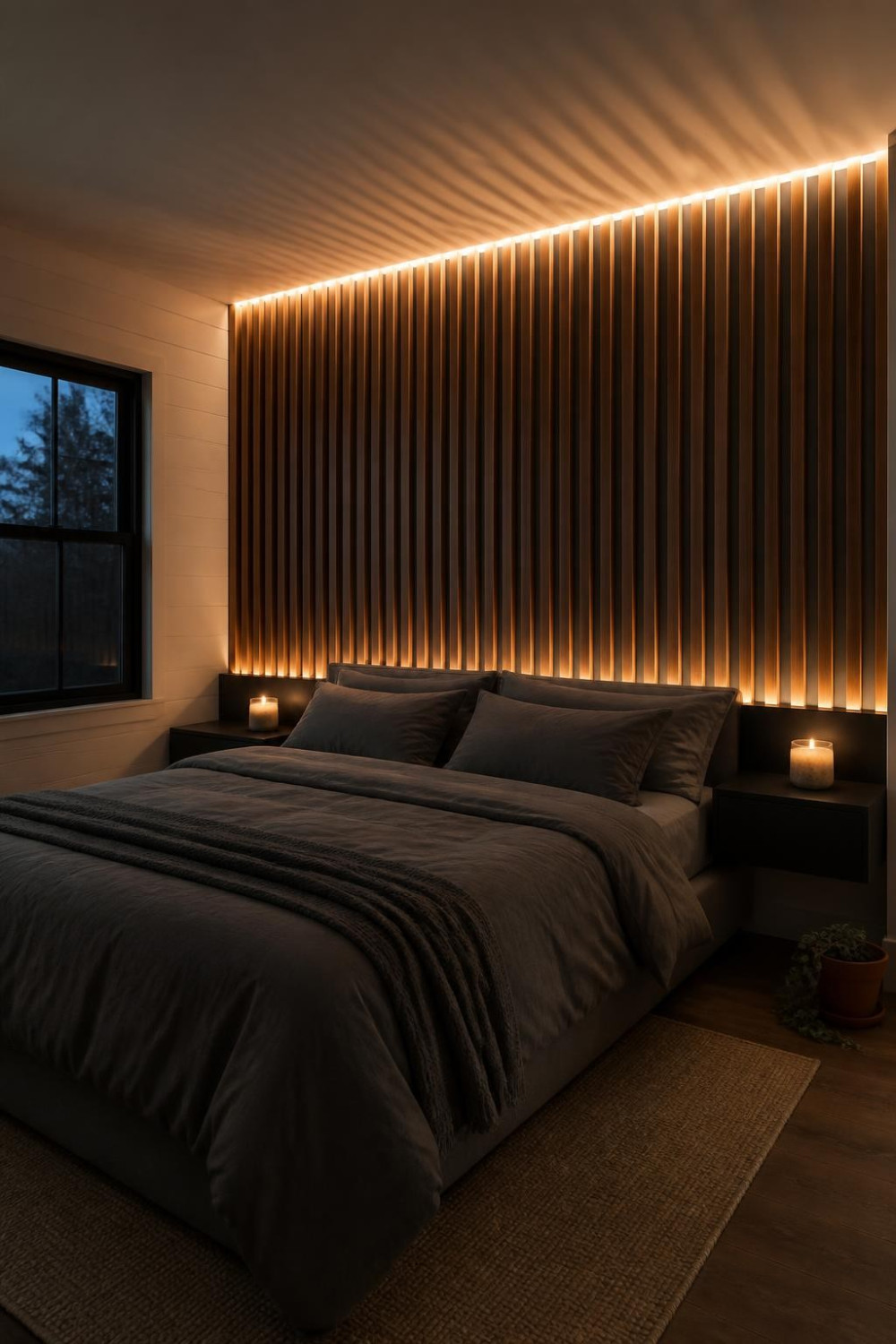
This one takes the wood slat wall from bedroom feature to full bedroom moment. Recessed LED strip lighting tucked behind the slats — either at the top edge, the bottom edge, or both — creates a warm ambient glow that looks incredible in the evening. The light bleeds through the slat gaps and casts soft striped shadows on the ceiling. You want a warm white LED (2700K to 3000K) here, not cool white — cool white completely kills the mood. The strips are low voltage and can be run to a dimmer switch or smart home control without much hassle. This works especially well if you don’t have bedside lamps and want to keep the nightstands minimal. Why it works: the LED strips are completely hidden during the day so the wall looks clean and architectural; at night it reads more like candlelight than a light fixture.
9. Wide-Plank White Oak Slats for a Warm Minimalist Bedroom
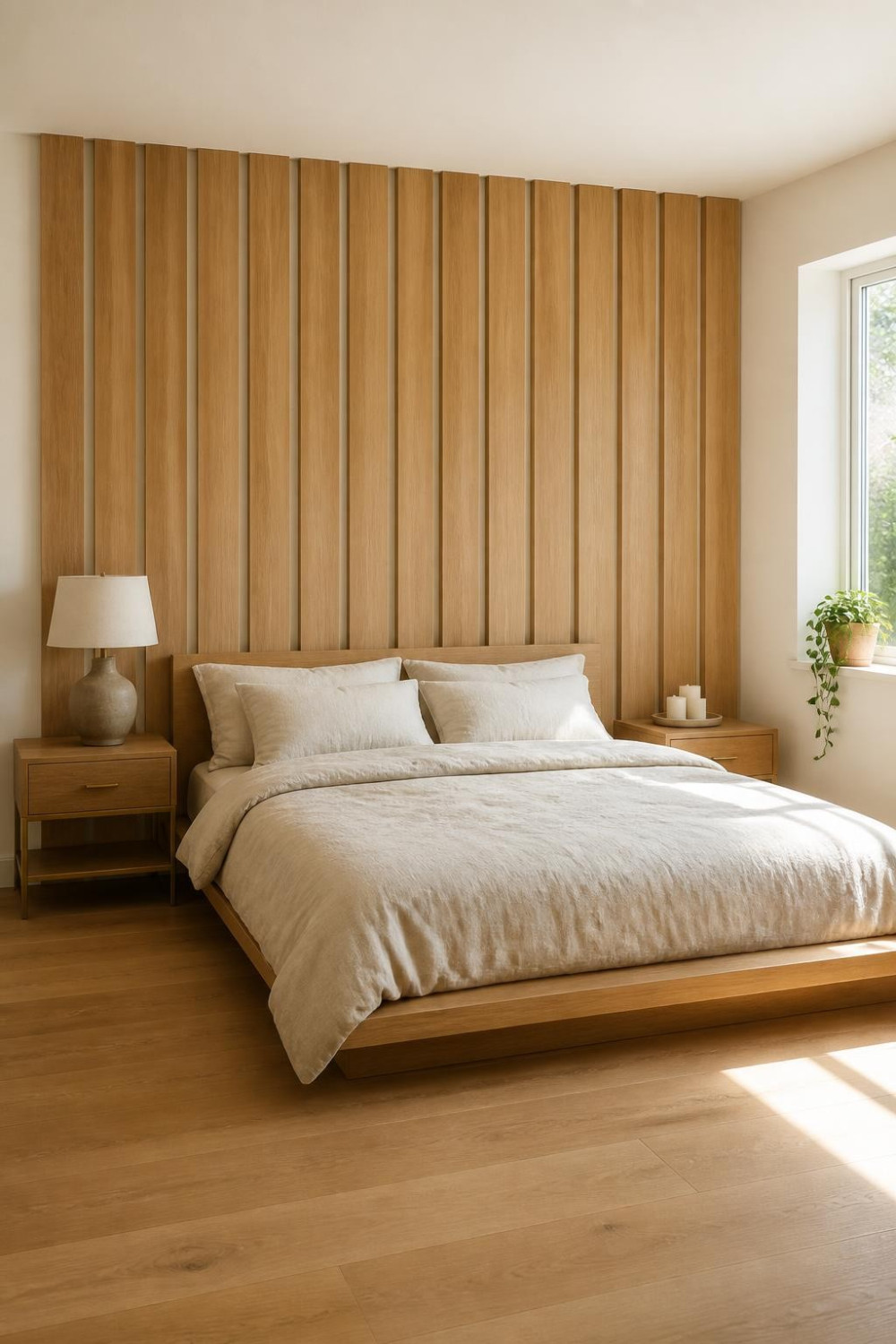
Wider slats — think 3 to 4 inches — with tighter spacing have a completely different feel from the typical narrow batten look. They read more substantial, almost like wide-plank wood paneling that breathes. White oak is the go-to here because its grain is tight and consistent, and it takes a natural matte oil finish beautifully. The result is quiet, warm, and very much at home in an organic modern or warm minimalist bedroom. It pairs best with undyed linen, natural ceramic finishes, and furniture in a similar tone family. Don’t go too matchy — contrast the slats with a slightly lighter or slightly darker furniture finish. Tip: wide-plank slats in white oak look best with a gap of roughly half the slat width — 1.5 inches of gap for a 3-inch slat — any tighter and it reads as solid paneling, not a slat wall.
10. Dark-Painted Slats Matching the Backer Wall for a Tone-on-Tone Effect
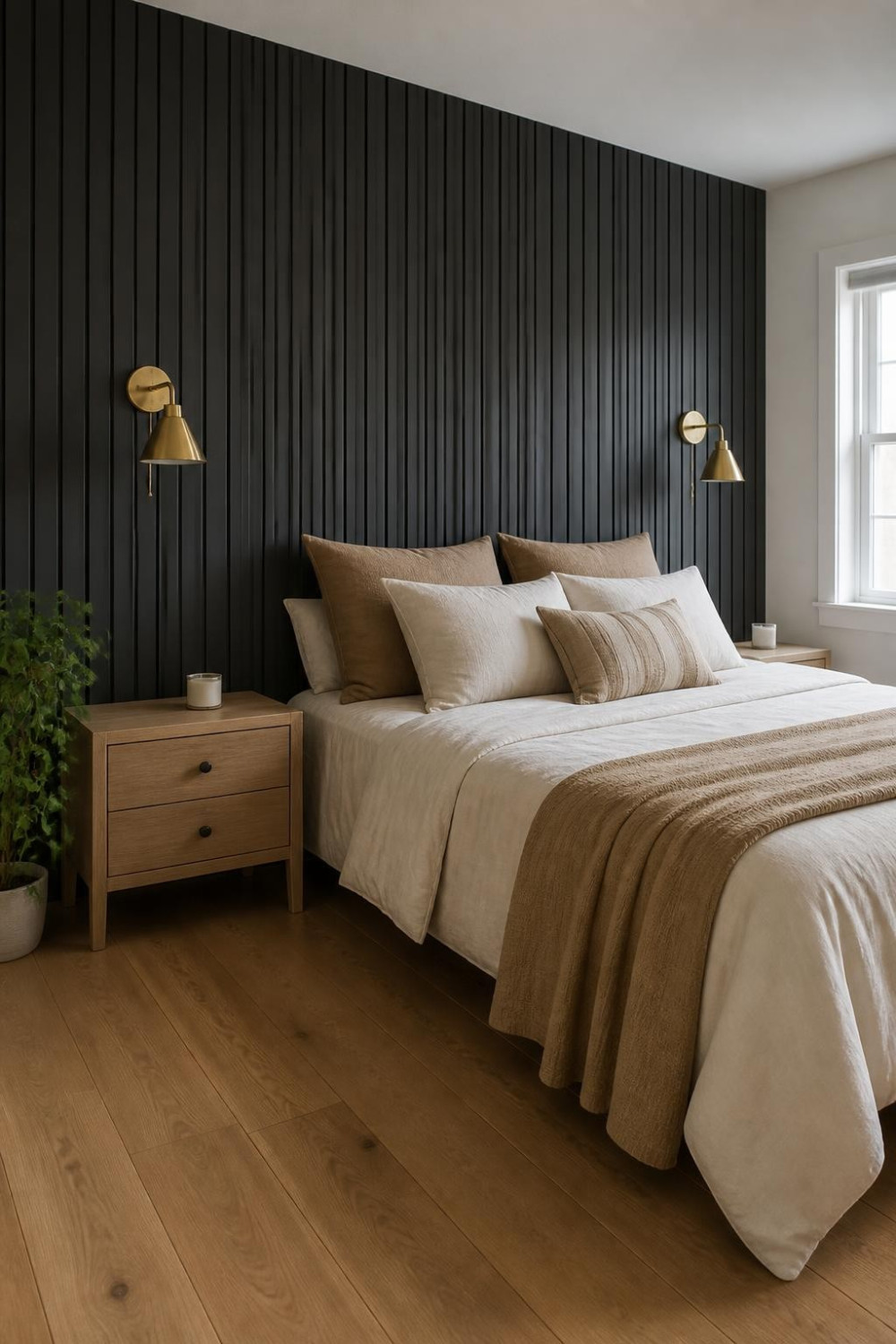
This is the subtlest version on the list and honestly one of the most sophisticated. Paint both the slats and the backer wall the same deep, moody color — a warm charcoal, an earthy brown-black, or a dark forest green — and the wall reads as a rich textured surface rather than a patterned one. The shadows between the slats become the pattern. It’s extremely hard to get wrong because there’s no color contrast to manage. It reads luxurious at a surprisingly low material cost. Use a matte or dead flat finish on both the wall and the slats; any sheen difference between the two surfaces will reveal itself under raking light. Why it works: tone-on-tone slats look intentional and architectural rather than decorative — it’s the difference between a design feature and a craft project.
11. Slat Wall Extended Horizontally Beyond the Bed Frame as a Full Backdrop
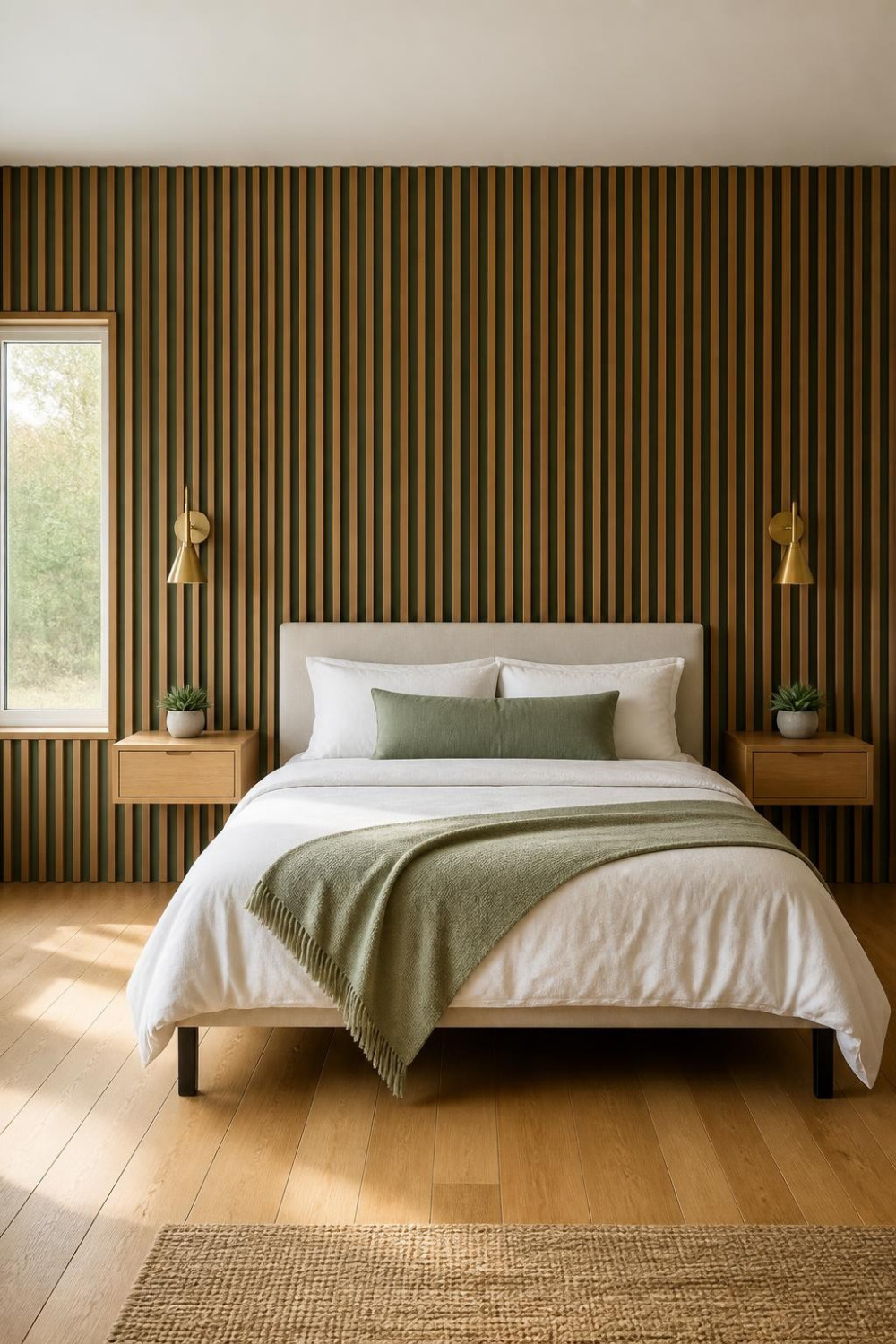
Take the floor-to-ceiling slat wall and run it the full width of the room — not just behind the bed, but edge to edge. This creates an immersive architectural backdrop that makes the entire bed wall feel intentional and finished. Floating nightstands and wall-mounted sconces live on the slat wall itself, which cleans up the floor plan and removes the need for freestanding lamps. It’s an especially strong move in a room where the bed sits on a very long wall with lots of space on either side. The slats provide the visual anchoring that keeps the furniture from looking like it’s floating in space. Pro tip: mount your sconces directly through the slats into the wall behind — use a stud finder first and run the wire before the slats go up to keep everything clean.
12. Japandi-Style Thin Slats with Deliberate Wide Spacing
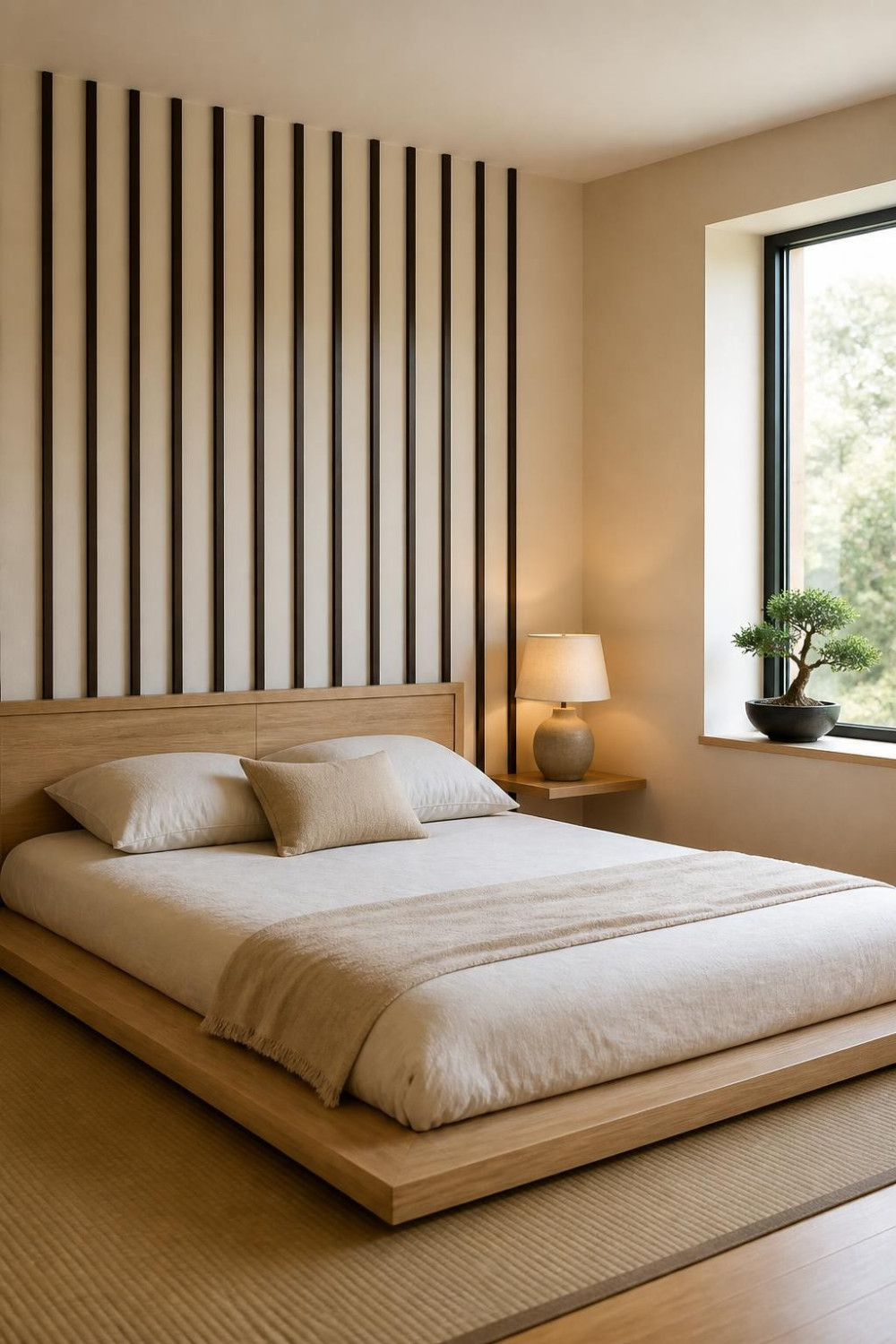
Japandi design is about restraint — and nothing says restraint like narrow slats with unusually wide spacing between them. Instead of the standard half-slat-width gap, push it to a 1:1 or even 2:1 ratio of gap to slat. What you get is a wall that shows as much of the backer color as the wood itself, making the backer color selection as important as the slat finish. Natural blackened cedar against a warm white wall is a classic Japandi pairing. It’s delicate, graphic, and extremely serene. Don’t rush it with thick slats — the whole effect depends on the slenderness. Swap: if blackened cedar feels too dark for your room, try a thin natural ash slat against a soft warm gray wall — still very Japandi, but lighter and easier to live with in a small bedroom.
13. Budget-Friendly Wood Slat Accent Wall Behind Bed Using Furring Strips
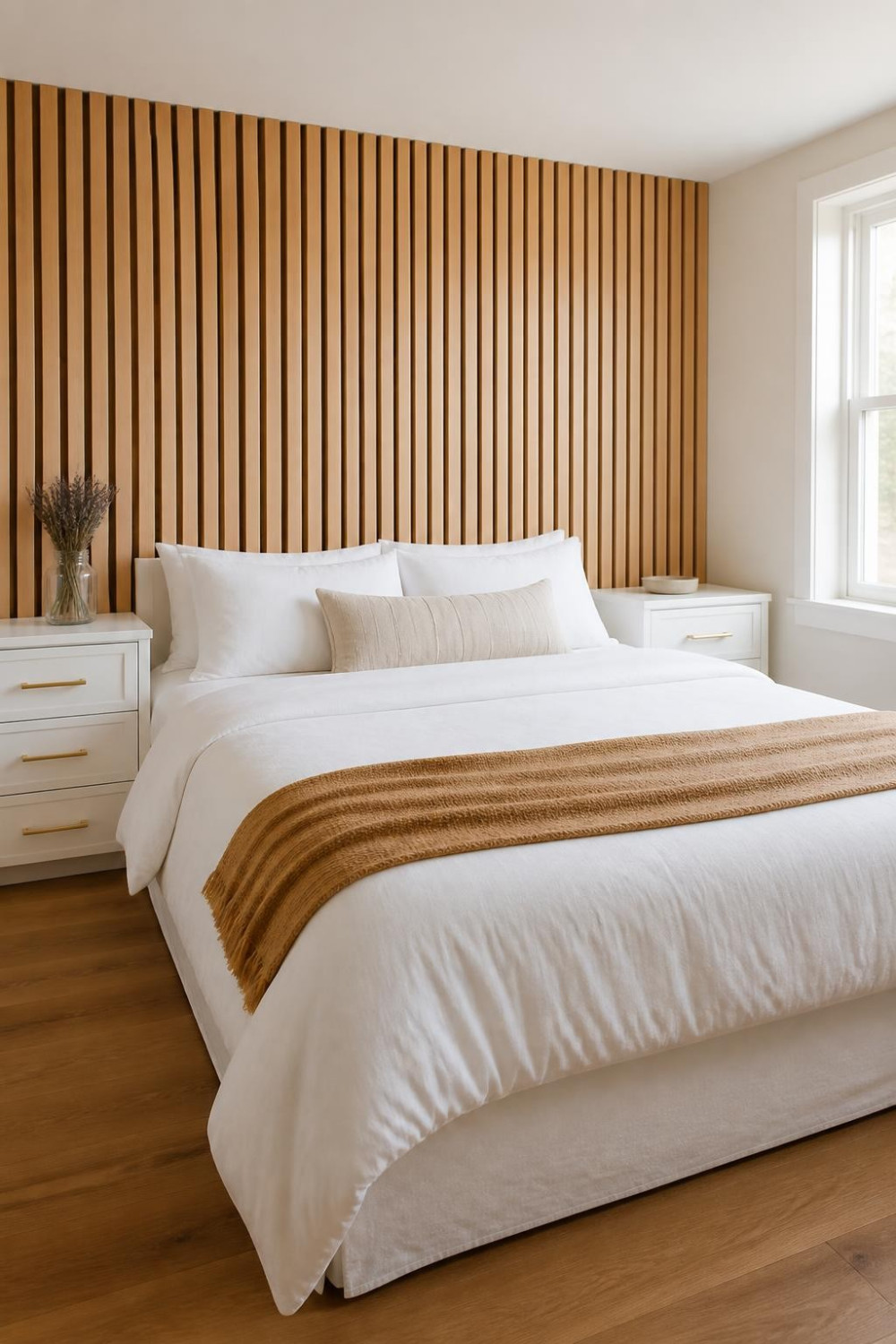
This is the version that costs under $150 and looks like it cost $1,500. Standard pine furring strips from the hardware store — the ones sold in bundles for framing — are exactly the right profile for a DIY slat wall. At $0.50 to $1 per linear foot, they’re absurdly cheap. Sand them smooth, prime them, and either paint them or apply a wood stain. Then nail or glue them directly to the wall over a painted backer. The whole project takes a weekend. The main limitation is that pine is soft and will dent and nick over time — keep that in mind if you’ve got kids or pets who share the bedroom. Tip: use a brad nailer rather than construction adhesive — it makes future removal or replacement of individual slats easy without tearing up the wall.
14. Mixed-Width Slat Wall for a Custom, High-End Look
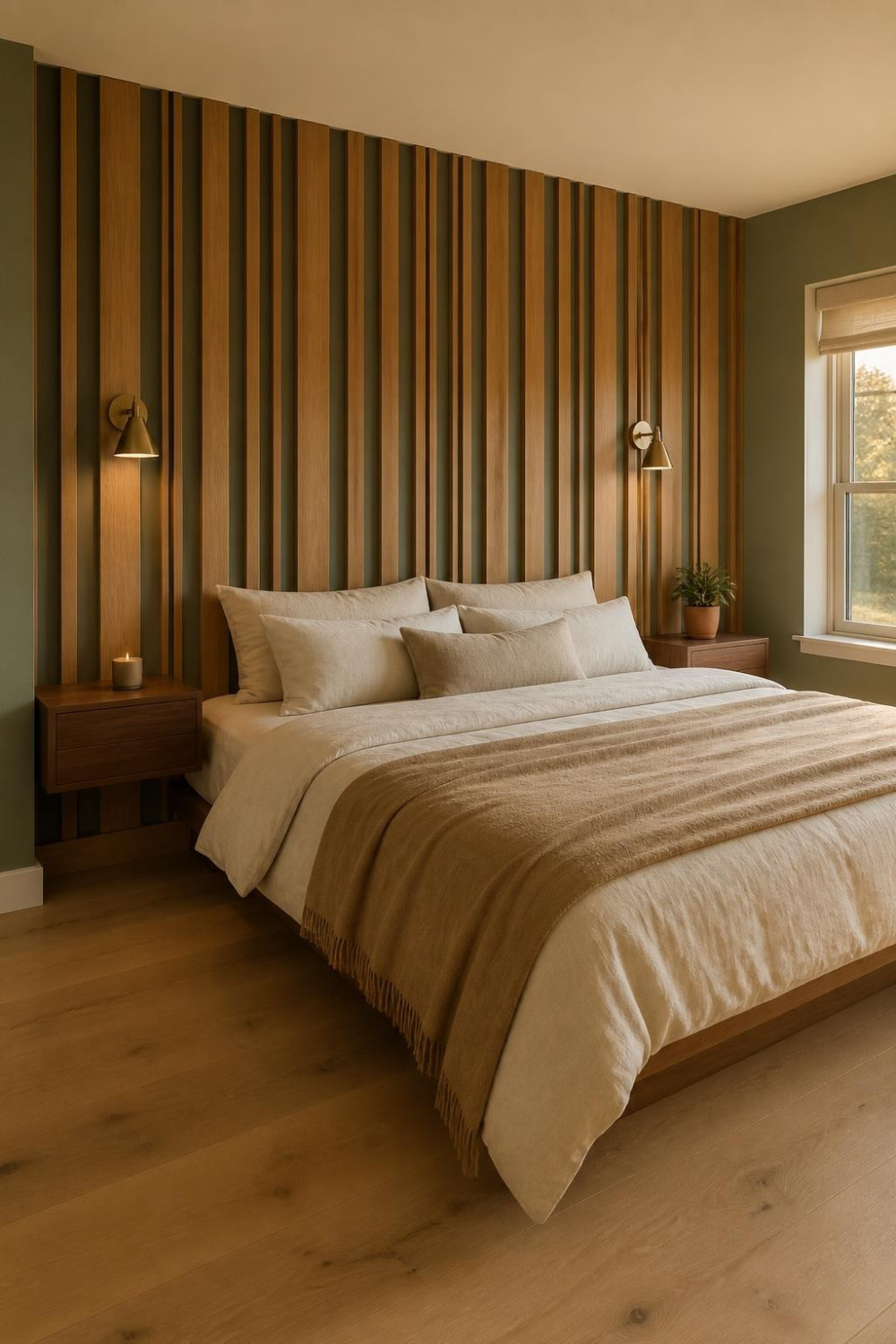
Standard slat walls use one consistent slat width throughout. Break that rule and suddenly it reads completely custom. Alternating between, say, a 1-inch and a 3-inch slat in a repeating pattern creates rhythm without chaos — the variation is controlled, not random. This is the kind of detail that makes a room feel like it was designed by someone who actually paid attention. It works best in natural wood tones rather than painted, because the variation in width looks most intentional when you can see the grain consistency tying it all together. It’s slightly more labor-intensive to install but the material cost is identical. Why it works: mixed widths trick the eye into registering the wall as custom millwork rather than a kit product — and that perception shift is exactly what makes a room feel expensive.
15. Curved or Arched Wood Slat Headboard Panel as a Sculptural Statement
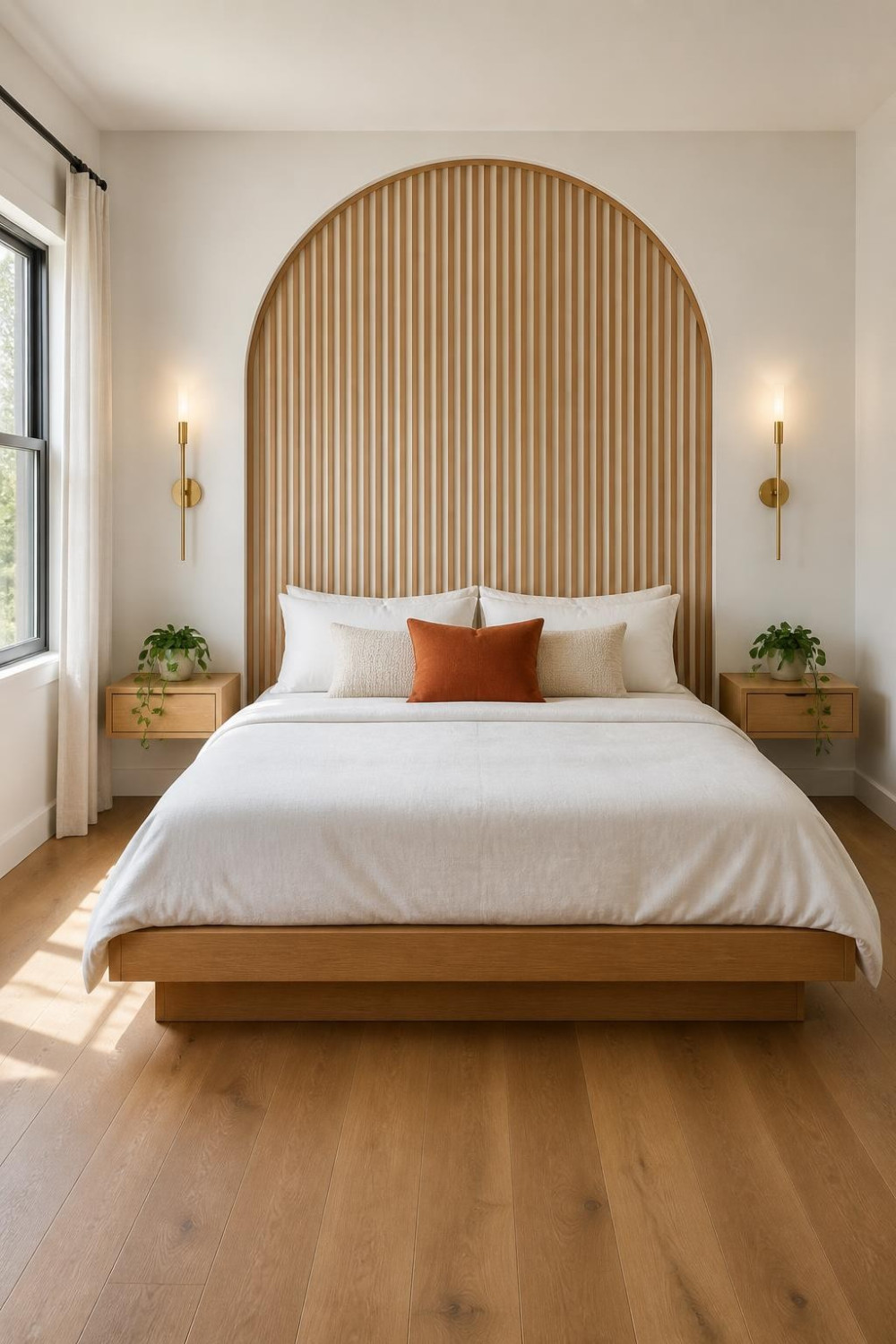
A slat panel doesn’t have to be a rectangle. Cutting the top edge of the panel into an arch — whether a soft semi-circle or a more angular peaked shape — turns the whole thing into a sculptural headboard that’s completely unique to your room. This requires either custom fabrication or some confident DIY work with a jigsaw, but the result is striking. The arch echoes classical architectural details while keeping the overall look very contemporary. It’s best suited to a primary bedroom where it can be the undisputed focal point — don’t put it in a room full of competing visual elements. Swap: if a full arch feels too complex, try a simple angled v-cut at the top of the panel — it reads sculptural and architectural with much simpler fabrication.
16. Reclaimed Wood Slat Wall Behind the Bed for Rustic Warmth
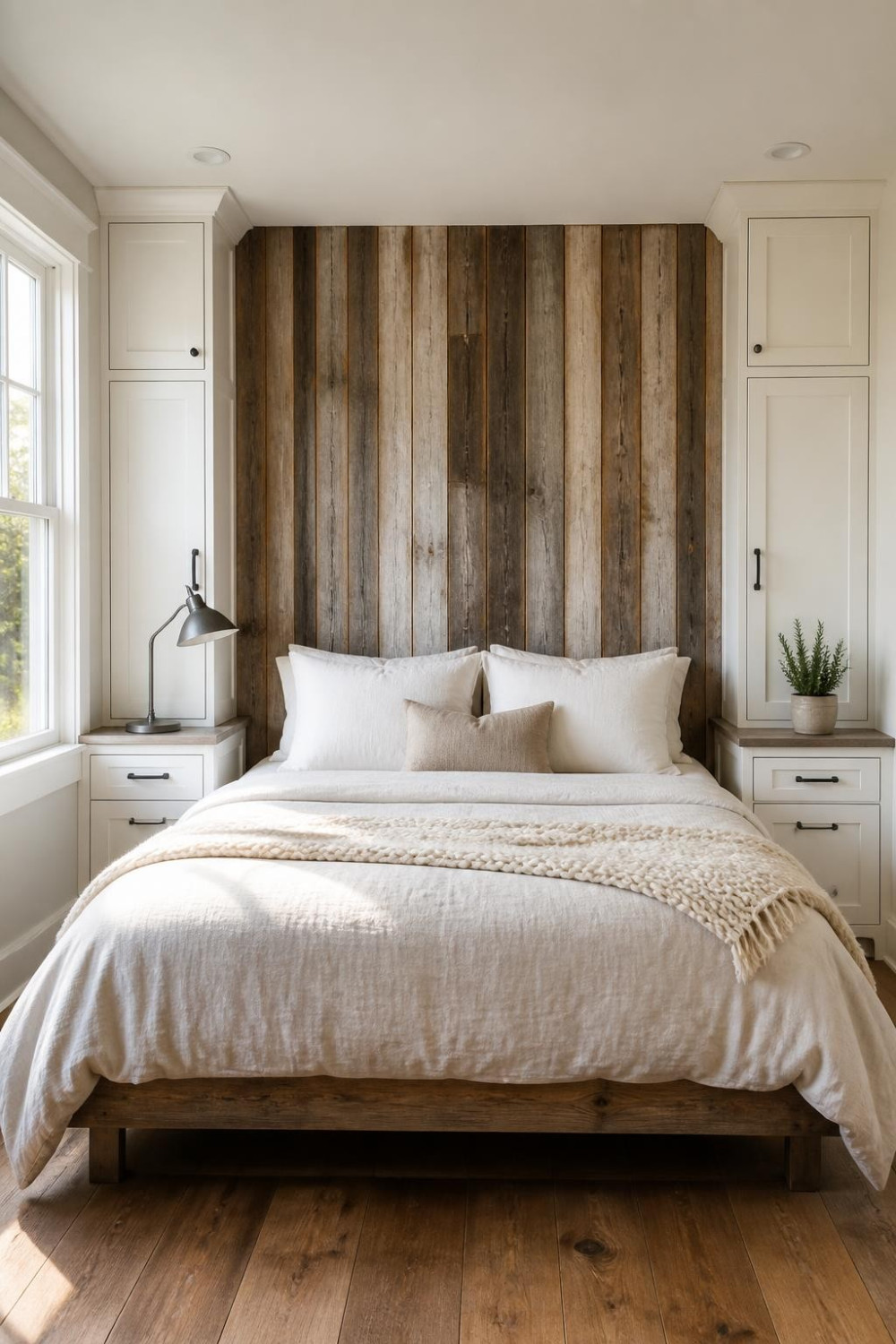
Reclaimed wood slats are a completely different animal from the clean, uniform panels most people picture. The variation in color, the old nail holes, the slightly uneven surfaces — all of that is the point. It brings a sense of history into the room that no new material can replicate. It suits a farmhouse bedroom, a rustic primary suite, or any space that leans toward collected-over-time rather than carefully curated. The installation is more involved because you’re working with irregular widths and variable thickness, so this is usually a weekend project with a helper. Source reclaimed barn wood from local salvage yards — you’ll get better material at a better price than buying pre-packaged reclaimed boards online. Tip: seal reclaimed slats with a clear matte wax or penetrating oil before mounting — it stabilizes the wood, reduces dust, and deepens the color without making it look processed.
17. Slat Wall in a Small Bedroom: Half-Wall Height Behind the Bed
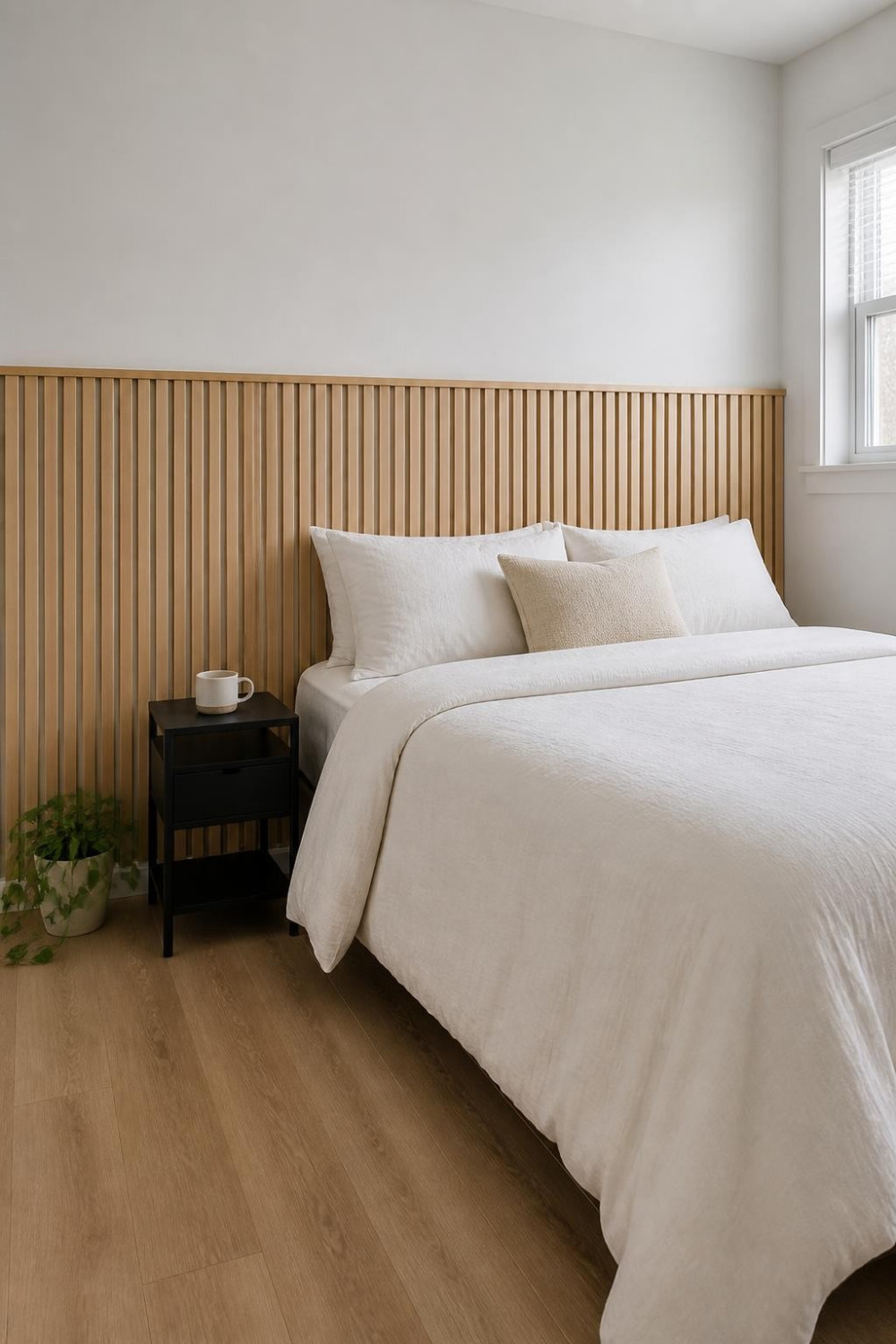
Small bedrooms have different rules. A full floor-to-ceiling slat wall in a tiny room can feel heavy and overwhelming — especially with dark wood tones. The solution is a half-wall-height panel: slats that start from the baseboard and stop at roughly 48 to 54 inches, right at the top of a standard headboard height. Above it, the wall stays painted in a light, airy tone. It defines the headboard zone clearly, adds all the warmth and texture you want, and leaves the upper portion of the wall open so the room breathes. This is also a smart option if you want the look but only have one wall of limited width to work with. Why it works: in small rooms, visual breathing room above the furniture is as important as the furniture itself — the half-height panel gives you the feature without sacrificing that openness.
Frequently Asked Questions
How much does a wood slat accent wall behind the bed typically cost?
A wood slat accent wall behind the bed can range from under $150 for a DIY furring strip version to $2,000 or more for custom-fabricated solid wood panels professionally installed. Pre-made veneer slat panel kits — the most popular middle-ground option — usually run $300 to $800 depending on the size of the wall and the wood species. Labor for professional installation typically adds another $400 to $800 on top of materials.
Should wood slats behind the bed be vertical or horizontal?
Wood slats behind the bed work in both orientations, and the choice really depends on your ceiling height and room proportions. Vertical slats draw the eye upward, making rooms feel taller — great for standard 8-foot ceilings. Horizontal slats ground the space and make a room feel wider, which suits lower-ceilinged or very square bedrooms. Most Pinterest-style bedroom inspo features vertical slats, but horizontal is genuinely underused and worth considering.
What color should I paint the wall behind wood slats?
The backer wall color behind your wood slats is one of the most impactful decisions in the whole project. A dark contrast color — charcoal, deep navy, forest green — makes the slats pop by creating shadow depth in the gaps. A lighter, matching tone gives a softer, more diffused effect. If you’re going for tone-on-tone, paint both the backer and the slats the same color for a sophisticated, architectural finish. Just avoid anything with high sheen since the glossy reflection between the slats gets distracting fast.
Can you do a wood slat accent wall in a rental apartment?
A wood slat accent wall behind the bed is achievable in a rental using peel-and-stick veneer panels, which come off without damaging drywall when removed carefully. Another renter-friendly option is a freestanding slat headboard panel that leans against the wall and isn’t attached at all. Always check your lease before making any wall modifications — even adhesive-backed panels can sometimes fall under restrictions. If you do go the peel-and-stick route, clean the wall thoroughly first and apply in warm, dry conditions for the best adhesion.
What bedroom styles work best with a wood slat accent wall behind the bed?
A wood slat accent wall behind the bed is one of the more versatile features in contemporary design — it reads naturally in Japandi, Scandi, organic modern, warm minimalist, and even rustic farmhouse spaces. The wood species and finish do most of the style-setting: light oak says Scandi or Japandi, walnut says modern luxury, reclaimed wood says farmhouse, and painted slats say whatever color direction your room is already going. The one style where it genuinely struggles is maximalist or heavily pattern-driven spaces where the geometric repetition of slats competes with everything else.